Voices from the Past

This forum is open to all of the villagers of Trelawnyd past and present


I would like for them to share their memories, old photographs, family histories and past Village news with me so that I may be able to present a comprehensive record of this small. ancient and facinating Welsh Village Community throughout the ages.


All photographs will be returned after being scanned and published

For those that want to read a comprehensive study on the History of Trelawnyd, please refer to the Book "TRELAWNYD PAST & PRESENT" by Daphne and Ken Davies

The Village Flower Show Blog can be viewed at

http://trelawnydflowershow.blogspot.com/
and my personal Village based blog can be seen at

http://disasterfilm.blogspot.com/

Best Wishes

John Gray

Trelawnyd 0845135466


Email : jgsheffield@icloud.com
Many thanks to the following citizens of Trelawnyd for their conributions so far:
Mrs Gwyneth Jones, Mrs Gladys Jones, Mrs Olwenna Hughes, Mr Trevor Evans, Mr Hubert Evans, Mrs Bryn, Davies, Mr Islwyn Thomas, Mrs Pat Bagguley, Mrs Joanne Hewitt, Mrs Beryl Evans, Mrs Daphne Jones, Mrs Audrey Jones,Mr Basil Davies, Miss Mona Davies, Mr Graham Jones. Mrs Iola Endres

Mrs Audrey Jones


Mrs Audrey Jones
Age 87
Years in the Village 87


"My Grandfather John Ithal Jones was born in your cottage.....the date was sometime in the 1870s...born and brought up in that cottage he was......When he married he had two daughters....my mother Ceridwen and my aunt Rose.
When my mother married they lived in the prefabricated house Winstays, which was at that time a shop which sold sweets , tobacco and the like . It was also  fish and chip shop!
I was born there in 1924. The Woman that delivered me lived in Erw Wen and was a midwife in Liverpool or the Wirral. Her husband came to the village as the baker.

Audrey and her brother "blacked up" outside Winstay Cottage with their father
The district nurse that usually attended the births was on holiday so this Mrs Leese came to my mother to help.
She only delivered two babies in the village...me and Bob Davies...she wasn't official or anything...she only came to help....people did in those days."

A rare photo of Winstay house with Audrey's father with the horse

"My father turned his hand to anything jobwise and got a job on the bins in the 1930s. His sister, Nellie Hughes was the landlady of The Crown and her husband Tom Hughes was the blacksmith. In the 1940s my father bought Gop Farm and I had so much to do with looking after the cattle I didn't have time to join in with the village's civil defence"
Trelawnyd's Wartime Civil defence.
Bessie Bryn Teg is on the second row 5th from left.
Audrey's best friend Megan Lewis who lived in number 1 London Road is bottom row 3rd from the right.
The shop keeper I.P Jones is on the top row 2nd from the left
Audrey could name all but two of this group


"Things could be tough in the village when I was growing up, but generally people shared what they had....I remember Ester Parry who was an older lady who lived in the house that was the Cross Keys pub at one time. She used to go from house to house around the village doing washing up here and peeling potatoes there...all for a meal!
She adopted a little boy who was called Frankie Chalk! That was his proper name! He was born out of wedlock to a woman who had a bit of money and every now and then she would come to visit and give old Ester Parry some more money.......apparently the father was in the navy"

"You know I remember the very first sixpence I ever saw! we were all round at Ester Parry's for a sing song and Hywel Stuart who used to play the piano accordion gave me a sixpence to go to the shop on Chapel Street for him. I had to buy 2 pence chocolate, a packet of woodbines and laces for his shoes! (she laughs)
funny what you remember after all these years isn't it?"
Audrey's family home. When Audrey married she farmed the next farm down the hill to Dyserth Ty Newydd
Audrey's husband Lennis lived at the oldest house in the village Siamber Wen before his marrage to Audrey

Snapshots of Trelawnyd by Trevor Evans

 Trevor Evans kindly sent me several slides documenting some of the buildings no longer present in the village.They prove to be a fascinating record of Trelawnyd in times gone by.

High Street. The Cottages on the left are all now demolished.
The building with the rounded steps was the location of the pub "The Black Boy"
Maldwyn "the Black" and Bob Y Black were well known villagers that lived there
Below is the same scene taken from the top of High Street


The Cottages on Upper Bonc Terrace before they were demolished
The Bottom of High Street showing the start of Mostyn Terrace
The Village before many of the newer bungalows were built.
The rectory drive can be seen ( Without trees)
The round concrete structure to the left of the photo was the top of a water tank


Bessie "Bryn Teg"


B.A.Jones (left) with her sister Ginny


Miss B.A Jones
"Bessie Bryn Teg"
Born 23.01.1903
Died 17.07.1990


There is perhaps a small handful of Village characters that linger long in the minds of the older residents of Trelawnyd to this day and one of the most well remembered and respected of those is Miss B.A Jones.
She is still referred to by many that were taught by her in the village school  as Miss BA Jones although many that worked with her on the many committees she helped to run call her simply as B.A. Jones.
Of course those that knew her well refer to her with her village nickname as "Bessie Bryn Teg"


Miss Elizabeth Ann Jones was born in 1903 at Pen Isa Mynydd in Cwm.
She moved with her younger sister to the small holding known as Bryn Teg sometime in the 1920s and from an early age she threw herself into village life, politics and affairs with some gusto, a passion she carried on throughout her 70 odd years as a Trelawnyd resident.
The photograph on the right is Bessie as a small girl.


Miss Jones is always referred to by villagers as the academic of the two sisters. Indeed one present day Trelawnyd resident described the pair thus:-
"B.A. Jones was the school teacher and literally ran the village..
Ginny stayed home and looked after the cow!"


Bryn Teg in its former glory
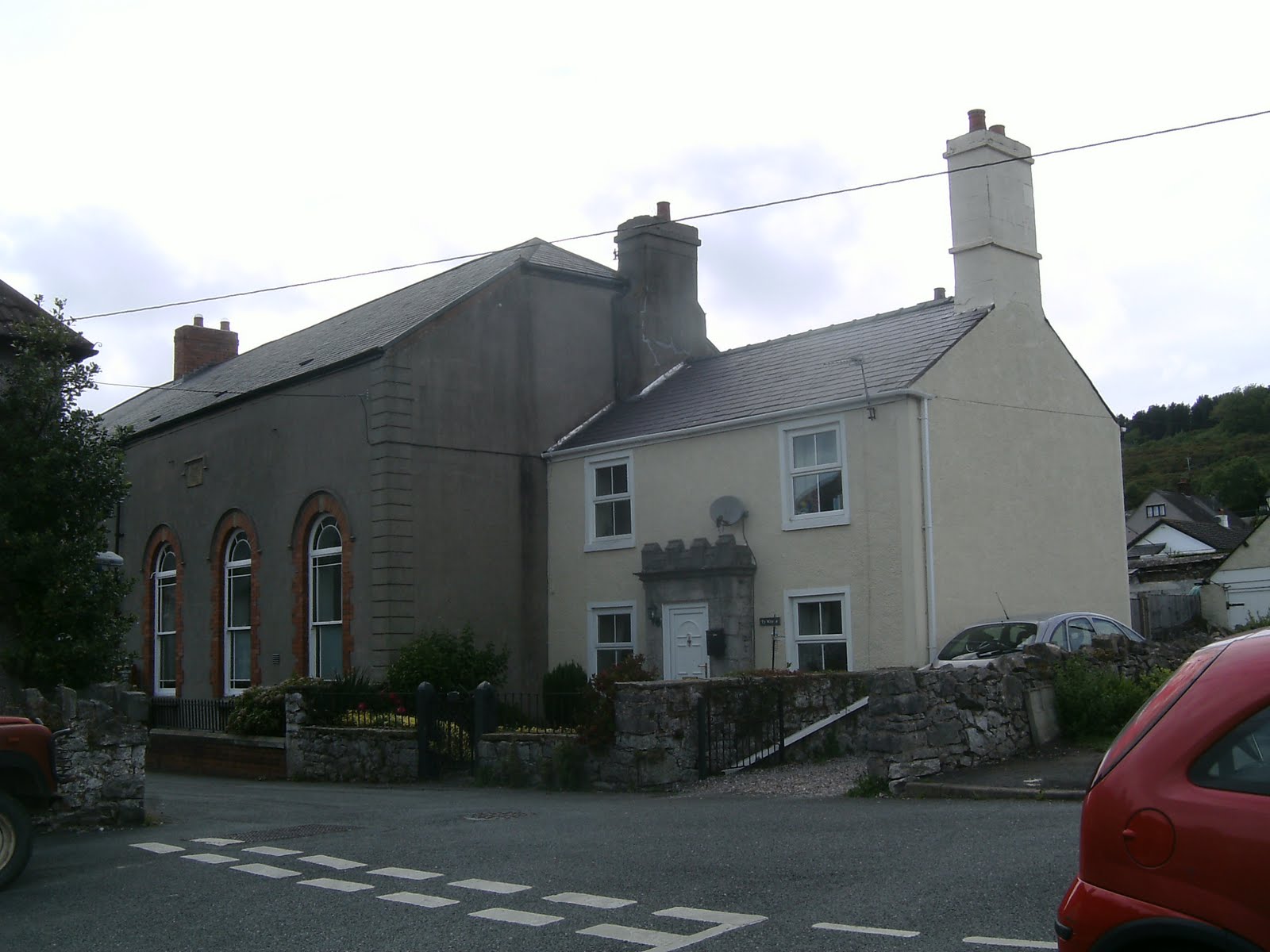
You can just see Ty Wynne and the Nonconformist Chapel to the left
Bryn Teg in 1982 before the modern bungalows "swamped it on all sides
Miss BA Jones ( left) with the village school staff in the 1950s
Miss Jones is always remembered as a "firm but fair" school mistress She instilled into her pupils punctuality and discipline ( she ran the Sunday school and the Girls society so woe betide any child not turning up for either of the extra school activity) and was not adverse from giving an over talkative pupil a sharp wrap over the knuckles with her ruler. (As Arfon Jones will testify to)......some former pupils do state that she could be overly harsh at times, but perhaps that was a sign of the times


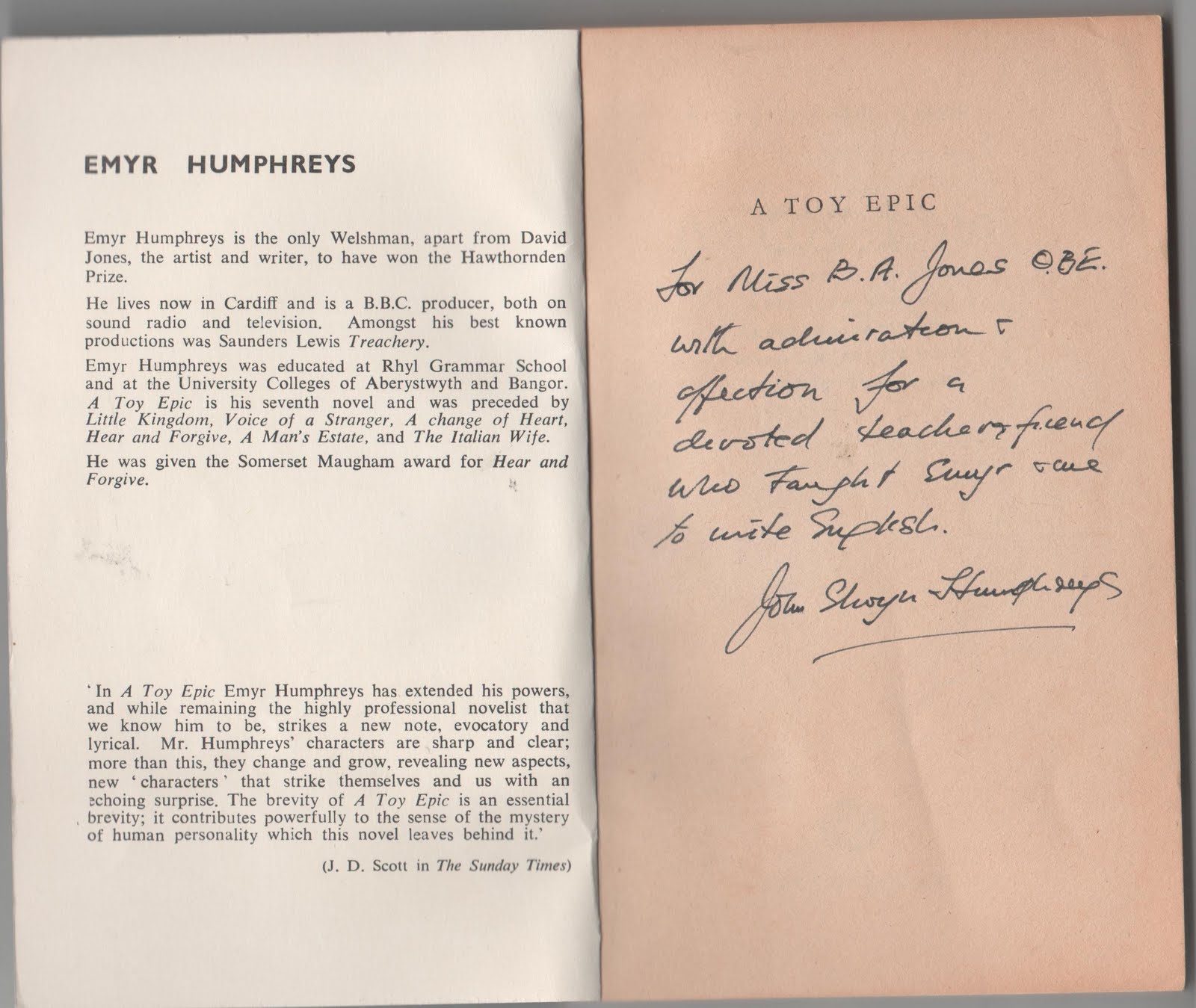
She taught the famous Welsh author  Emyr Humphreys whose father left a rather touching dedication to her in his son's  novel "A Toy Epic" John Humpreys was the village school headmaster for many years.


 The dedication states
"For Miss B.A.Jones O.B.E.
with admiration and affection for a devoted teacher/friend...who taught Emyr to write"


He refers to Miss Jones as being an O.B.E. but in actual fact Miss Jones was awarded the British Empire Medal in the 1960s for her community work (below)
The B E M

A letter signed by The Queen detailing B.A's award


Miss Jones was an integral part of village left.
She was an active member of the Wartime Defence , the Village Welfare committee , The Church ( where she played the organ for decades and refused to give up the organ key to anyone!) and later in her life she ran the Flower Show Committee with precision and care.
She ran the village Girls' Society, The Sunday School and played a huge part in The British Red Cross and the Woman's Institute as well as a score of other societies out of the village.
Bessie "Bryn Teg" dedicated a lifetime of service to the community of Trelawnyd.
A service record that should be remembered for many years to come
B.A Jones ( centre bottom row) with the rest of the village welfare committee


The Ghost of John Wynne?

John Wynne's family lived in a mansion which is now Gop farm
 
According to Bangor Professor Robert Jenkins the industrial pioneer John Wynne (1650-1714) was instrumental in the development of Newmarket. He had a vision of developing the hamlet into a market town proper. He built houses, established a weekly market and established the Nonconformist chapel in 1701 as well as building a grammar school at "plas yn dre".
His wish to develop Newmarket into a large market town ultimately came to nothing, but Wynne was responsible for the village's growth and its population did top over 600 residents.
John Wynne died n 1714 and his remains was buried against the wall of the Chapel which still exists in Chapel street.
Ty Wynne ( or Wynne House) which adjoins the Chapel wall where John Wynne is supposedly buried
Now all this gives a little background to the "ghostly" goings on at Ty Wynne, which is the house situated right next door to the chapel and John Wynne's burial place. The present owner always thought that their house was haunted by a strong male character. Indeed the lady of the house always made a point of saying "goodnight" to the ghost before she went to bed. They always presumed that the "ghost" was that of John Wynne
In the early 1970s Ty Wynne featured in a somewhat creepy tale. Local small older Graham Jones was just leaving the memorial hall one wintry and rainy night.. He had been playing snooker  and as he got on his bicycle he saw a figure of a man standing in the gateway of Ty Wynne.
The man was wearing an old fashioned long coat and hat, and seemed to acknowledge Graham before he cycled for home.
Literally a minute later Graham approached his home along London road and was astonished and frightened to see the same man standing alone outside his own home!
Graham wisely stopped and returned for the morale support from his friends back in the hall and by the time he returned mob handed the "man" had vanished
Could the figure be that of Trelawnyd's founder John Wynne?
Who knows?


As a footnote , I have added this faint clipping from the 1908 "Welsh Coast Pioneer"
It shows a very old photograph of the chapel prior to the insertion of the large windows. It looked very much like a large cottage rather than the chapel that we know today

Trelawnyd Carnivals

A carnival from 1952 with a most unlikely and dare I say unattractive gaggle of  "carnival Queens"
It was held on the fields in front of Erw Wen

The 1995 carnival programme designed by Tim Jones
The late Pat Ellis (centre) surrounded by village children

Thanks to Peter Ellis for the loan of the photographs

Mr Basil Davies/ Miss Mona Davies


Mr Basil Davies                                                                             Miss Mona Davies

Basil and Mona's Grandfather lived in the police house Bryn Hyfryd which is located in the village at the junction of High Street and the lane to the farm "Ochr-y-Gop"

He was then the village policeman and in this photograph which was taken at the turn of the century he can be seen standing before the typically rural looking home which did in fact house a functioning prisoner cell. although it is unknown whether or not it was ever used. One of the little girls is Basil and Mona's mother


Bryn Hyfryd
  Basil " Most villagers in those days had their own policeman. Trelawnyd, Dyserth and even Llanasa had one.
The policemen in those days were tough, big men who had to be able to handle themselves and as you can see my grandfather was a broad chap"

Mona and Basil's mother and father went on to farm Ochr-y-Gop, which is one of the grandest farm houses in the village. Apart from Mr Bryn Davies (Chapel House) Basil and Mona are the only two Trelawnyd residents that still live in the house in which they were born.
The Beautiful Ochr-y-Gop (above) before it was obscured by the Maes Offa Bungalows
This family bill from 1921 is the November and December bill covering bread purchased from Siop Newydd (G.O.Griffith)
Note the penny red which was applied as "bill paid"
Hubert Evan's father at the bakery next to the Mostyn Arms probably sold the bread to Siop Newydd

School Children at the village school around the 1940s
Basil is the second boy on the left
The girl in the centre of the group with her smiling head raised is Daphne Jenkins
Pat Bagguley is just behind her to the left ( with all the hair)
 
This fascinating document is an invoice of payment from the point of Ayr mine to Mona and Basil's father for the rather larger sun of twenty Nine pounds/ ten shillings.
The date was 1921 and Basil suspects that it was payment for Haylage for the mine's pit ponies

Basil and Mona highlight a common but hitherto largely unsaid phenomenon from the 1920s and the 1940s, and that was the fact that times were very hard indeed.
"We used to have a a great many tramps turning up at the farm. Men without a home or a job. Many would work on the farm, paint a wall or so for some food and a bed for the night. They used to sleep up in the hay loft where it was warm, but my father always used to demand that if they had a box of matches on them, they would have to hand them over to him...my father would not risk a fire"
Audrey Jones in her testimonial told a story that an old lady from the village Ester Parry, used to come to their family farm (Gop Farm) just to darn socks . Her payment again would be a meal or a bag of potatoes.
   OlwennaHughes recalls that most people had their own piece of land given over to the growing of vegetables. Indeed the allotments for Bonc terrace can be still seen today and have recently been converted back to their allotment roots.  Pat  Bagguley also recalles a local piece of history when around ninety years ago a local man who was down on his luck lived and indeed died in the Dove house of Gop farm ( below)
                    

                                                 Milk delivered by Basil and Mona's Brother Tommy ( known as Tommy Ochr-y-Gop) around 1960. The horse was called Polly.                                                                                               

An Overview

From all of the previous resident testimonials, I am beginning to glean together a picture of what the "old" Trelawnyd might of looked like.
This old survey map published well before  1962 shows clearly some of the features before Rhoda Arthur, the pensioner bungalows and Bron Haul were developed.
Interestingly it shows The Historic Offa's Dyke transecting the village opposite The Crown Pub where the new Park Offa is now located


Key:


  1. The Site of the Livestock Market "Cae Sale"
  2. The "Roft" 
  3. The Wynstay Pre Fabricated house and Wynstay Cottage
  4. The tree lined drive to the Old Rectory
  5. The Carnival field in front of Erw Wen
  6. The old High Street Houses and Cottages before Bron Haul
  7. The old Cottage above the village
1 "Cae Sale"

The old Police station on London Road
"Cae Sale" was the site of a livestock market. In the above picture, although not clear you can see a flat area of land just before Upper Bonc Terrace ( the row of cottages in front of the larger Plas yn Dre to the left of High Street).Pat Bagguley and daughter Joanne remember playing on the site as children, though it had not been used as a market since the early 1930s.
.Trevor Evans recalls that the village boys sometimes used the auctioneer's ring as an improvised boxing ring after the market was run down
In front of "cae sale" you can just make out the roofs of Bryn Hyfryd Cottages and just after that the detached farm house that is called simply "Bryn Hyfryd". Bryn Hyfryd at one time was the village police station. The police station was then moved to a house on London Road (next to the school)


2 The Roft
Just to the right of High Street and obscured by the trees was a patch of overgrown allotments and "rough ground" which was called The Roft . The site of the Roft is now the Entrance to Bron Haul


Looking down High Street Today.
The Roft would have been on the right of the road.
To the left is Bryn Hyfryd. "Cae Sale" would have been situated beyond Bryn Hyfred's garden
3 The Wynstay "prefabricated" Bungalow
Audrey Jones of Gop Farm and Ty Newydd Farm remembers her grandparents living in the Wynstay Bungalow. It was an old army structure lifted directly from Kinmel Camp in the 1920s
It was part house, part shop and later in its existence became a popular fish and ship shop, complete with a small dining area. A small holding was attached to it.
This rare photograph Shows Audrey Jones' Grandfather behind the "Prefabricated house"
The Wynstay Bungalow was situated at the end of Chapel Street and was flanked by Wynstay Cottage which has now been demolished and which is the site of a bungalow.
The site of the Wynstay Bungalow today
Wynstay Cottage Roof can be seen to the right
.

Gwyneth Evans (left) who still lives in the village and Jean Roberts outside Wynstay's shop


4 The Entrance to The Rectory

The once imposing drive, to the rectory which was lined with trees is alas no more

The Rectory Entrance as it is today
5 The "Carnival field opposite Erw Wen

This  photograph  taken at Trelawnyd Carnival on Coronation Day 1953 has been included as a bit of fun. It Shows John Richard Morris Roberts, Kinsey Roberts and Edwina Fidgeon celebrating the day.
The photograph also shows Erw Wen just across the road.

London Road/ Erw Wen Today
6 The Old Houses and Cottages on High Street

Where the Sheltered Housing is located today up to Bron Haul used to be situated a row of houses and cottages. At varying times The pubs The Black Boy and The Cross Keys were situated along this row.

7.The Old Cottage "Ar y Gop"
Hidden away behind some newer buildings is an old cottage Ar y Gop
Islwyn Thomas stated that he was born in a stone cottage which was located in this area.
This photograph  could well be the cottage in question
(if anyone can verify this please could they contact me)